
Hosted by Preya Patel, Managing Director of Raw Knowledge, with guest speakers Mark Kerns, CEO of Adapa Advisory, and Ian Woodhouse, Strategy Advisor at Multrees Investor Services.
Data management has quietly become one of the most significant strategic challenges facing wealth management firms. What was once considered a back-office responsibility is now top of the strategic agenda, driven by rising client expectations, increasing regulatory scrutiny and the growing need for scalable, data-driven operating models.
The webinar explored the realities of modern data management and how firms can turn high-quality data into a competitive advantage. The discussion focused on how firms can overcome data silos, reduce operational complexity and build the trusted data foundations needed to support growth, improve client outcomes and enable future innovation.
Key Takeaways:
- Data has moved from an operational concern to a board-level priority.
- Fragmented data remains a major obstacle, with firms often managing information from multiple providers and systems.
- Unstructured data remains one of the biggest barriers to scale and automation.
- The most successful firms are tackling data challenges through focused use cases rather than broad, large-scale transformation programmes.
- Good data foundations are becoming essential for improving client outcomes, meeting regulatory obligations and supporting future innovation.
- Automation can significantly reduce manual effort, allowing teams to focus on higher-value activities.
Why Data Has Moved Up the Agenda
Data has always been important, but attitudes towards it have changed dramatically in recent years.
Data is becoming more complex, client expectations continue to rise, and regulators increasingly require firms to evidence decisions, outcomes and compliance. At the same time, firms are looking to improve efficiency, scale operations and respond to growing volumes of data across the business.
As Ian Woodhouse explained in the webinar, data now sits at the heart of client reporting, regulatory obligations, operational resilience and future growth. Firms are moving towards more connected, data-driven operating models, making strong data foundations increasingly important.
The proliferation of AI has also brought existing data challenges to the surface. As Mark Kerns noted in the webinar, the rise of AI and large language models has “exaggerated the focus on getting data right” as without clean, trusted and well-governed data, these emerging technologies can simply compound existing issues and inaccuracies.
What’s Holding Firms Back?
If the need for better data is widely recognised, why are so many firms still struggling?
The discussion highlighted several obstacles:
- Legacy systems often weren’t designed to work together, making integration difficult and resource intensive.
- Manual processes remain embedded in day-to-day workflows.
- Governance can vary significantly across teams and business functions.
- Identifying, cleaning and integrating data continues to require substantial effort.
There is also a broader organisational challenge. For many years, data was treated primarily as an operational or technology issue. Today, firms recognise that improving data quality requires buy-in across the business, not just within IT teams.
Challenge One: Fragmented Data
Many firms are working with data from multiple providers, custodians, platforms and internal systems, each supplying information in different formats and with varying levels of quality. The result is significant operational effort spent reconciling data and deciding which version can be trusted.
Pricing data provides a good example: firms may receive prices from a primary vendor, backup provider, custodian and administrator, with differing values creating confusion and unnecessary reconciliation work. The discussion highlighted the importance of establishing trusted sources and clear fallback rules to create a more consistent view of data.
Preya Patel pointed out that the same challenge often applies to financial identifiers and classifications, noting that establishing an agreed version of the data can help eliminate many of the issues firms experience day to day.
In the discussion, the panel emphasised that firms make the greatest progress when they focus on priority use cases rather than attempting to solve everything at once. Mark Kerns explained: “it’s identifying use case number one, solving it. Identifying use case number two, solving it. And gradually, you’re building up over time.”
Challenge Two: Complex and Unstructured Data
While structured data is generally becoming easier to manage, unstructured data remains a significant challenge across the industry. PDFs, fund manager reports, corporate action notices, emails and client communications all contain valuable information, but extracting and standardising that information remains difficult and time-consuming.
As firms expand into more complex asset classes, particularly private markets, the volume of unstructured information continues to grow. For many organisations, this creates operational bottlenecks and makes it more difficult to automate processes at scale.
As Ian Woodhouse put it: “Fundamentally, if you’re storing everything as unstructured PDFs on a file server somewhere then you’re going to have problems.”
The panel agreed that addressing these challenges requires more than technology alone. Stronger processes, standardisation and governance are equally important.
Challenge Three: Manual Workflows
Despite significant investment in technology across the industry, many organisations still rely on manual processes to capture, validate and move data between systems. This limits scalability, increases costs and introduces opportunities for error.
The challenge is not just the volume of manual work, but the impact it has across the business. As Ian Woodhouse highlighted during the discussion, improving operational efficiency remains one of the most compelling use cases for better data management.
To illustrate how firms are tackling this challenge, Preya Patel led a demonstration of Raw Knowledge’s Managed Smart Data (MSD) platform. The demo showed how data can be automatically standardised, validated and corrected, with only critical exceptions requiring manual review. In one example, more than 2,000 corrections were processed automatically, while just 12 records required human intervention.
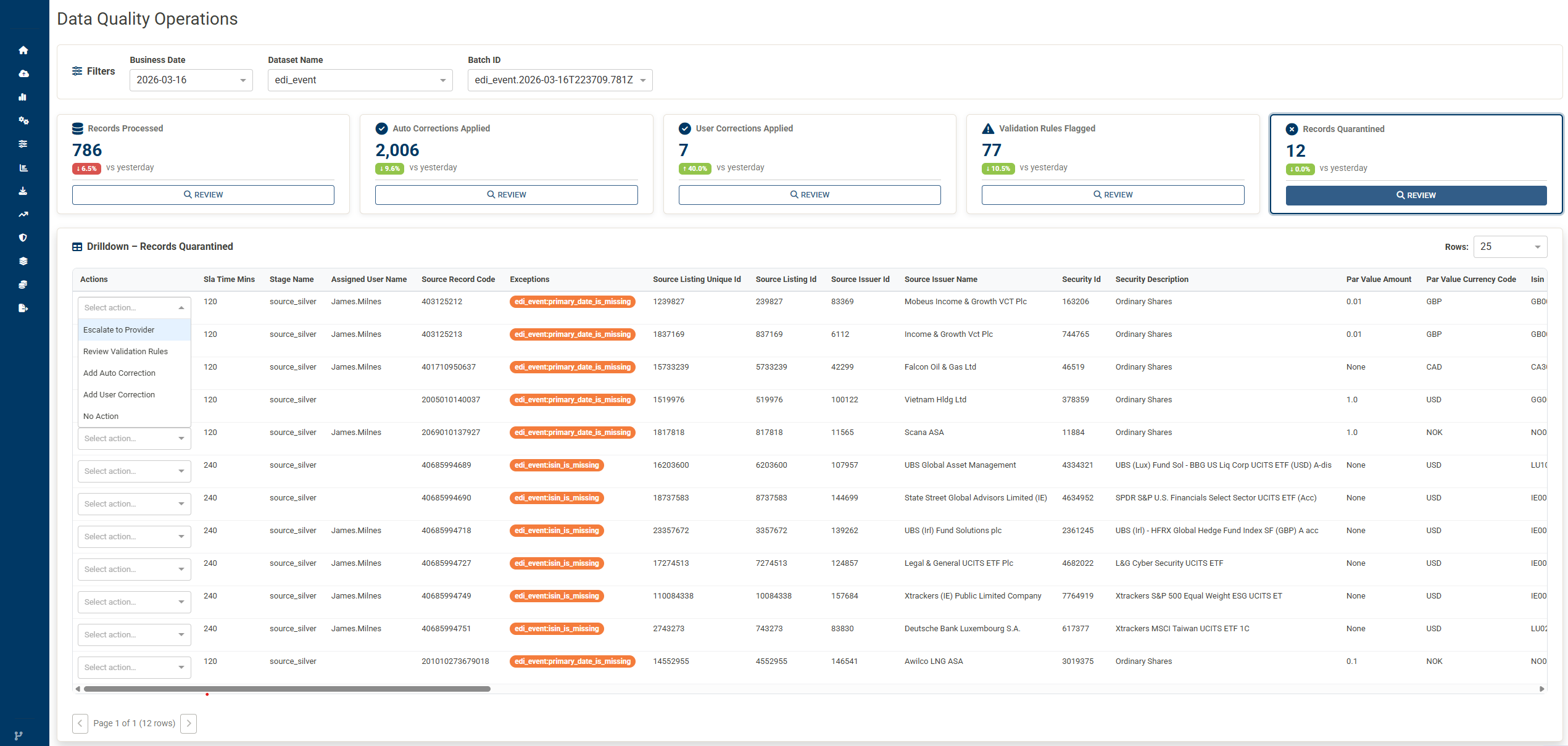
By reducing manual effort, firms can improve data quality, improve turnaround times and deliver accurate, up-to-date information to clients more quickly, while supporting better reporting and decision-making.
What’s Actually Working?
The discussion concluded with a clear message: firms do not need to replace every system or solve every data challenge at once. Instead, the organisations making the greatest progress are focusing on practical, measurable improvements and building from there.
Successful firms are:
- Starting with high-impact use cases.
- Building around existing systems rather than replacing them.
- Establishing clear governance and ownership.
- Bringing the wider business into the process.
- Measuring success through tangible business outcomes.
- Building trusted data foundations before accelerating AI initiatives.
Perhaps most importantly, firms are recognising that good data underpins everything else. Whether the objective is improving reporting, responding to regulation, supporting growth or making greater use of AI, success depends on trusted, well-governed and accessible data.